




Executive Summary
This report provides an overview of the global optical metalens industry, highlighting key developments, market size, growth drivers, application trends, competitive landscape, and future outlook.
Table of Contents
1. Market Overview
1.1 Market Definition
1.2 Market Size and Growth
2. Key Growth Drivers and Trends
2.1 Key Drivers
2.2 Key Trends
2.3 Future Outlook
3. Key application scenarios
3.1 Major Applications of Optical Metalenses
3.2 Market Size of Key Downstream Industries
3.3 Key Market Drivers and Trends in Key Downstream Industries
1. Market Overview
1.1 Market Definition
The optical metalens is defined as a flat lens technology that utilises metasurfaces to focus light. This technology is applicable in optical systems that leverage the advantages of a flat surface, offering higher focusing efficiency, tunability, and other benefits that help reduce thickness while improving optical performance compared to traditional curved refractive lenses commonly used in conventional optical devices. The global optical metalens market is still in the early stages of commercialisation. As design and manufacturing technologies mature and awareness of the technology increases worldwide, it is expected that more companies will enter the field in the future.
1.2 Market Size and Growth
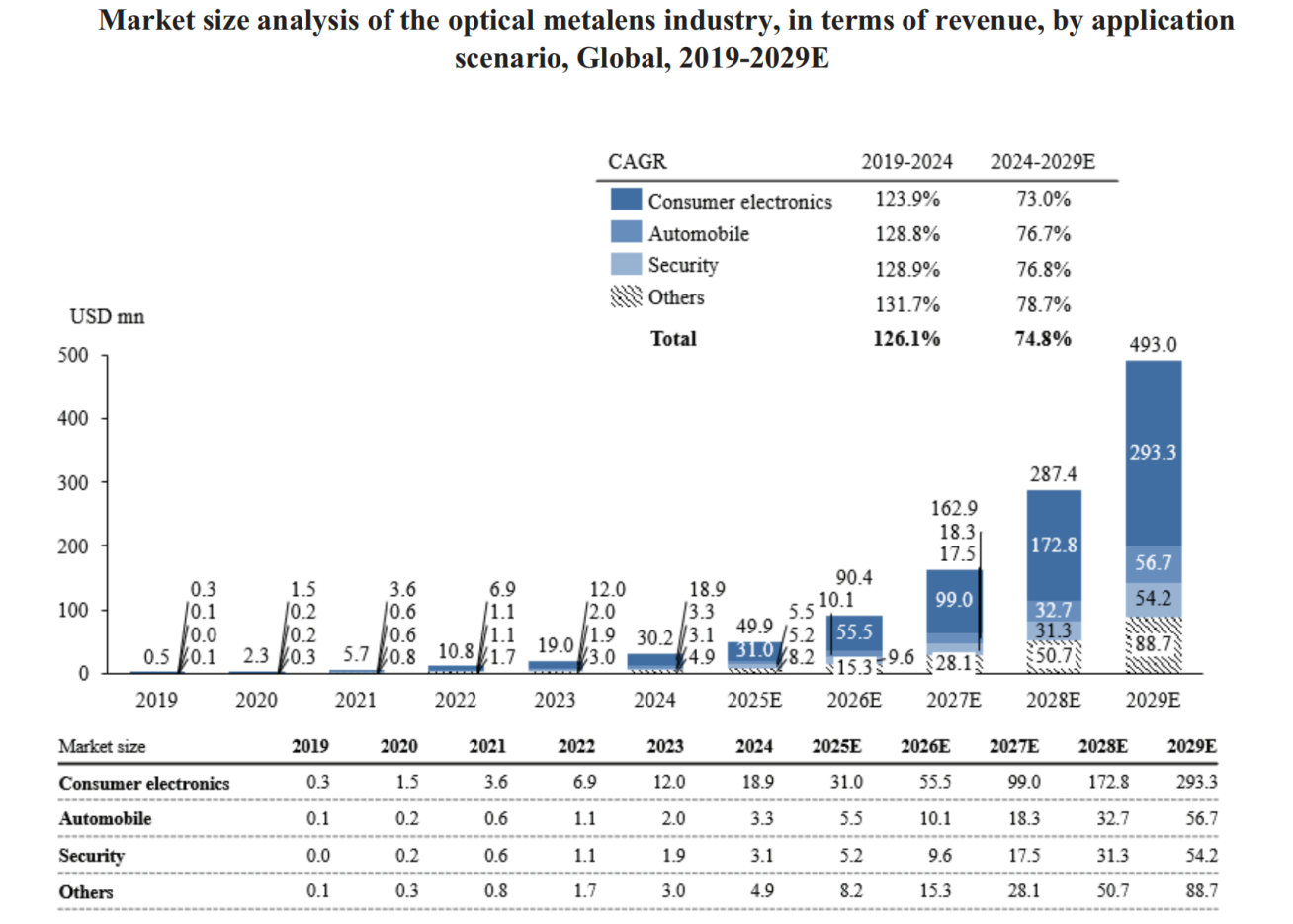
The global optical metalens market has entered a high-growth phase. From 2019 to 2024, the market expanded from USD0.5 million to USD30.2 million, representing an extraordinary CAGR of 126.1%. This rapid growth was primarily fueled by early-stage adoption in consumer electronics and rising awareness of the technology's potential. By 2029, the market is projected to reach USD493.0 million, with a CAGR of 74.8% from 2024 to 2029.
Source: CIC Reports
2. Key Growth Drivers and Trends
2.1 Key Drivers
Strong support ecosystem and incentive policies
The optical metalens industry is driven by a robust global support ecosystem characterized by strategic government incentives, tax reductions, and R&D grants. Deep collaboration with world-class research institutions provides essential access to elite talent and state-of-the-art facilities.
Furthermore, a mature semiconductor and precision manufacturing base offers an integrated supply chain ideal for scaling production. Recent large-scale investments in industrial-grade fabrication facilities and cleanroom infrastructure are accelerating the transition from lab-scale prototyping to commercial deployment, allowing companies to enhance R&D and capture emerging market opportunities.
Technological breakthroughs in optical metalens
Historically, metalens adoption was limited by chromatic aberration and scalable manufacturing challenges. Recent advancements in dispersion engineering and multi-layer architectures have significantly mitigated these distortions. Furthermore, the integration of AI-driven computational imaging allows for real-time restoration and aberration compensation. By pairing metalens hardware with deep learning post-processing, the industry can now achieve high-resolution, full-color imaging within a compact form factor, overcoming prior technical bottlenecks and enabling broad commercial deployment.
Rapid growth of downstream industries
The demand for portable, high-efficiency optical solutions is surging in consumer electronics, particularly for smartphones and AR/VR devices. Beyond consumer gadgets, the integration of metalenses is accelerating in autonomous driving and biometric systems (such as facial recognition), where high-resolution imaging and sensing are critical. By offering a thinner profile and superior light manipulation, metalenses provide a transformative alternative to traditional optics across these diverse, high-growth sectors.
2.2 Key Trends
Advancements in fabrication technologies
The transition from laboratory research to mass production is accelerating through scalable, high-throughput manufacturing processes. The industry is shifting from E-beam lithography to industrial-grade DUV immersion lithography, enabling nanoscale precision compatible with semiconductor standards. Furthermore, innovations in integration allow metalenses to be fabricated directly onto optical fibers, waveguides, and VCSELs, creating highly compact multifunctional modules. Future developments are expected to focus on dynamic, tunable, and reconfigurable metalenses, further expanding their operational versatility.
AI-driven design and optimisation
The integration of AI and nanophotonics is transforming metalens development through deep learning and inverse design. These AI-powered algorithms accelerate the discovery of optimal geometries, enabling unprecedented precision in controlling polarization, aberration, and focal lengths. Beyond individual components, AI facilitates the system-level co-design of the entire optical stack, optimizing performance across hardware and software. As models mature, AI is expected to enable real-time adaptive systems that respond dynamically to environmental inputs, unlocking new capabilities in computational imaging, AR, and autonomous systems.
Growing penetration rate and wider application of optical metalenses
The integration of optical metalenses is expanding beyond consumer imaging into high-end scientific instruments, automotive sensors, near-eye displays, and space optics. Ongoing research is pushing boundaries into frontier fields such as quantum optics, holography, and optical computing. Driven by increasing venture funding and a growing ecosystem of specialized start-ups, the technology is evolving to meet sophisticated industrial demands. This continuous improvement in functionality and efficiency reinforces the role of metalenses as a disruptive force across both commercial and scientific optical sectors.
2.3 Future Outlook
The optical metalens industry is transitioning into a mature, commercially viable sector, driven by scalable fabrication and AI-driven optimization. The adoption of DUV immersion lithography and semiconductor-compatible processes ensures high-volume, cost-effective production, while AI-enhanced inverse design enables precise control over complex optical properties like aberration and polarization. Beyond traditional imaging, applications are expanding into quantum optics, holography, and autonomous systems. Supported by robust ecosystem funding and sophisticated downstream demand, the industry is poised for widespread adoption.
However, the path forward is protected by significant entry barriers: the high technical complexity of sub-100nm wafer-scale patterning, the massive capital investment required for specialized semiconductor infrastructure, and the formidable intellectual property portfolios held by early leaders. These factors create a steep threshold for new entrants, ensuring that companies with end-to-end capabilities and established IP are strategically positioned to lead the next generation of transformative optical technology.
3. Key application scenarios
3.1 Major Applications of Optical Metalenses
Optical metalenses feature an ultra-thin, planar structure and precise control over light’s phase, amplitude and polarization, enabling miniaturized, high-performance optical systems that drive innovation across multiple sectors. In 2024, consumer electronics and automotive were the top two application fields, accounting for 62.6% and 10.9% of the global industry revenue respectively.
Consumer electronics: Metalenses are widely used in smartphones, AR/VR devices, smart home/IoT hardware and projectors. They correct chromatic aberration with compact flat designs, helping slim down smartphone imaging systems and replace conventional lenses. For AR/VR, they reduce the size and weight of head-mounted devices. In IoT and projection scenarios, they miniaturize optical sensors, boost light control and deliver high-resolution imaging for portable and embedded systems.
Automotive sector: Metalenses act as a next-gen optical solution for LiDAR, in-cabin monitoring, ADAS and vehicle cameras. Their compact design simplifies sensor assembly and saves space, while their high heat resistance outperforms polymer optics in high-temperature VCSEL-based LiDAR systems, ensuring stable performance for autonomous driving and safety.
Security: Metalenses support broadband infrared and multispectral imaging, delivering clearer visuals in low light. Combined with deep learning, they upgrade image quality and enable compact 3D biometric sensing for facial recognition and identity verification.
Telecommunications: They improve signal focusing and reduce loss in fiber-optic communication, supporting higher data speeds for 5G and satellite communications, while miniaturizing optical components and cutting costs.
Industrial applications: Metalenses enhance precision optical inspection for semiconductor wafers and laser processing including lithography and cutting, improving defect detection and manufacturing accuracy.
Biomedical applications: Their compact planar structure fits miniaturized medical devices, enabling thinner, less invasive probes and improving patient comfort in minimally invasive procedures.
3.2 Market Size of Key Downstream Industries
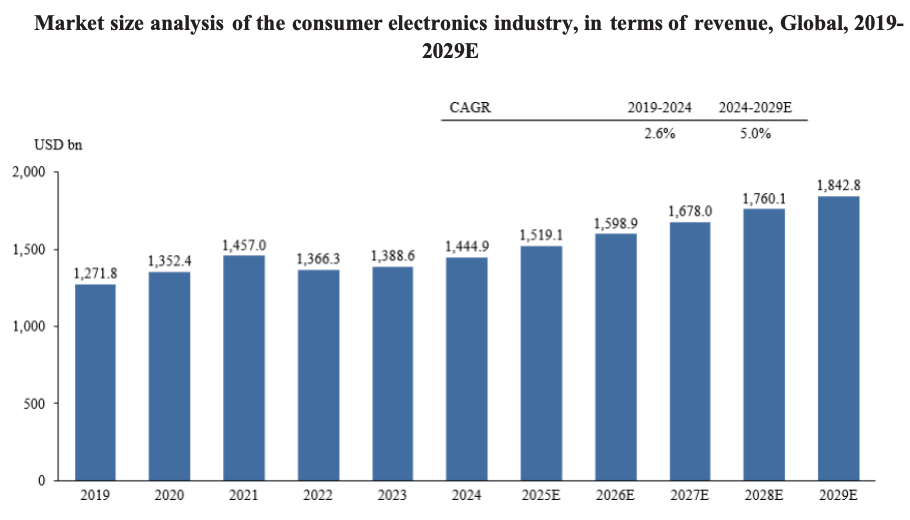
The global consumer electronics market saw volatile growth from 2019 to 2024, expanding from USD1,271.8 billion to USD1,444.9 billion at a 2.6% CAGR. Driven by pandemic-induced remote work and home entertainment demand, it peaked at USD1,457.0 billion in 2021, but declined and became saturated in 2022–2023 due to weakened non-essential demand, overconsumption and high prices. The market rebounded in 2024 as supply chain bottlenecks eased, while falling inflation and economic growth boosted consumer spending power. Driven by technological innovation and new application demands, the market is forecast to grow at a 5.0% CAGR from 2024 to 2029, reaching USD1,842.8 billion by 2029.
Source: CIC Reports
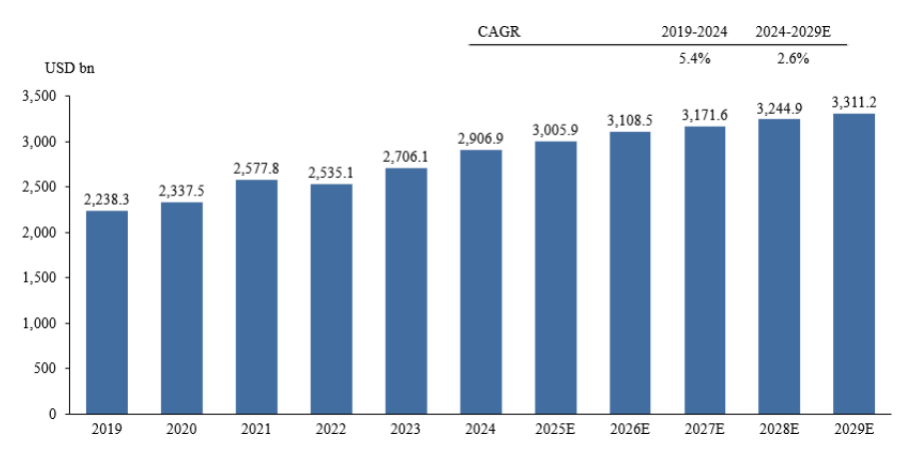
The global passenger car industry grew steadily at a 5.4% CAGR from 2019 to 2024, expanding from USD2,238.3 billion to an estimated USD2,906.9 billion. However, it stagnated in 2021–2022 due to lingering pandemic impacts, semiconductor shortages, logistics bottlenecks, raw material price hikes, and uneven regional demand amid economic uncertainties. Looking ahead, the market is projected to grow at a slower 2.6% CAGR from 2024 to 2029, reaching USD3,311.2 billion, supported by rising EV demand, urbanization in emerging markets, and advancements in connected/autonomous vehicle technologies.
Source: Extracted from Organisation Internationale des Constructeurs d’Automobiles ,CIC Reports
3.3 Key Market Drivers and Trends in Key Downstream Industries
The global expansion of the optical metalens industry is primarily driven by an escalating demand for miniaturisation and lightweight designs, where ultra-thin nanostructured surfaces replace bulky traditional lens stacks to enable slimmer smartphones and ergonomic AR/VR headsets. This shift is further propelled by the demand driven by rapid iteration in consumer electronics, as manufacturers leverage metalenses to deliver high-resolution imaging and facial recognition within increasingly compact, competitive form factors. Additionally, the increasing demand for LiDAR and ADAS technologies is fueling adoption in the automotive sector, where metalenses optimize autonomous sensing by enhancing beam focusing and field of view.
Future trends in the global optical metalens industry in key downstream industries are defined by a more replacement of traditional optical lenses and adoption in next-generation consumer electronics. This evolution is further catalyzed by AR/VR innovations and near-eye display enhancements. Furthermore, metalenses are foundational to the rise of holographic display technology, providing the precise phase and wavefront control necessary for 3D projection and light-field imaging within compact form factors.
About CIC
CIC is a professional consulting firm offering tailored end-to-end support across the full investment and financing lifecycle. The firm boasts a world-leading track record in guiding landmark first-in-sector IPOs across global markets, alongside unrivaled reach and in-depth coverage capabilities across specialized niche market segments.
CIC helps enterprises refine scalable business models and craft compelling capital narratives to enable seamless access to global capital markets, while serving as a trusted due diligence partner to investment institutions. It delivers granular industry insights and direct access to subject matter experts, empowering clients to identify high-value opportunities and mitigate critical risks effectively.
CIC team maintains deep, real-time market intelligence across a diverse set of sectors—including financial services, artificial intelligence, big data, internet, high technology, healthcare, education, entertainment, consumer goods, transportation and logistics, energy and power, environmental and building technology, chemicals, industrial manufacturing, and agriculture—delivering unparalleled access to sector-specific, actionable insights.
CIC Reports & Industry Overview
At CIC, we employ a rigorous, multi-method research framework, combining primary and secondary sources to underpin our analysis. Primary research involves in-depth engagements with industry thought leaders and practitioners, particularly in supply chain finance. Secondary research synthesizes publicly available datasets from authoritative bodies, including the National Bureau of Statistics of the People’s Republic of China, the State Administration of Financial Regulation (SAFR, formerly the China Banking and Insurance Regulatory Commission), the China Securities Regulatory Commission (CSRC), and public company filings. We apply proprietary data analytics frameworks to process collected information, validating findings through cross-referencing data from multiple research streams to ensure analytical rigor and reliability.
All statistical data presented is verifiable and grounded in information available as of the date of this report.
Extracts are refined summaries of in-depth CIC industry research reports, highlighting supply and demand trends, key growth drivers, R&D trends and future outlook, etc. of various segmented fields, integrating multi-dimensional insights such as expert interviews, market surveys and industry data analysis.
Disclaimer
This report (the "Report") is prepared by CIC based on information available as of the date hereof. The Report is furnished strictly for informational and reference purposes only and is not intended to, nor shall it be construed as, being definitive or conclusive. Nothing contained herein shall constitute or be deemed to constitute investment advice, a recommendation, or an offer, solicitation or inducement to engage in any investment activity. CIC hereby expressly disclaims any and all liabilities for any loss, damage or claims of any nature howsoever arising, whether directly or indirectly, from the use of or reliance upon any information contained in the Report.
Contact CIC
For more information about this report or to learn more about CIC services, please visit CIC official website , or email us at marketing@cninsights.com.
